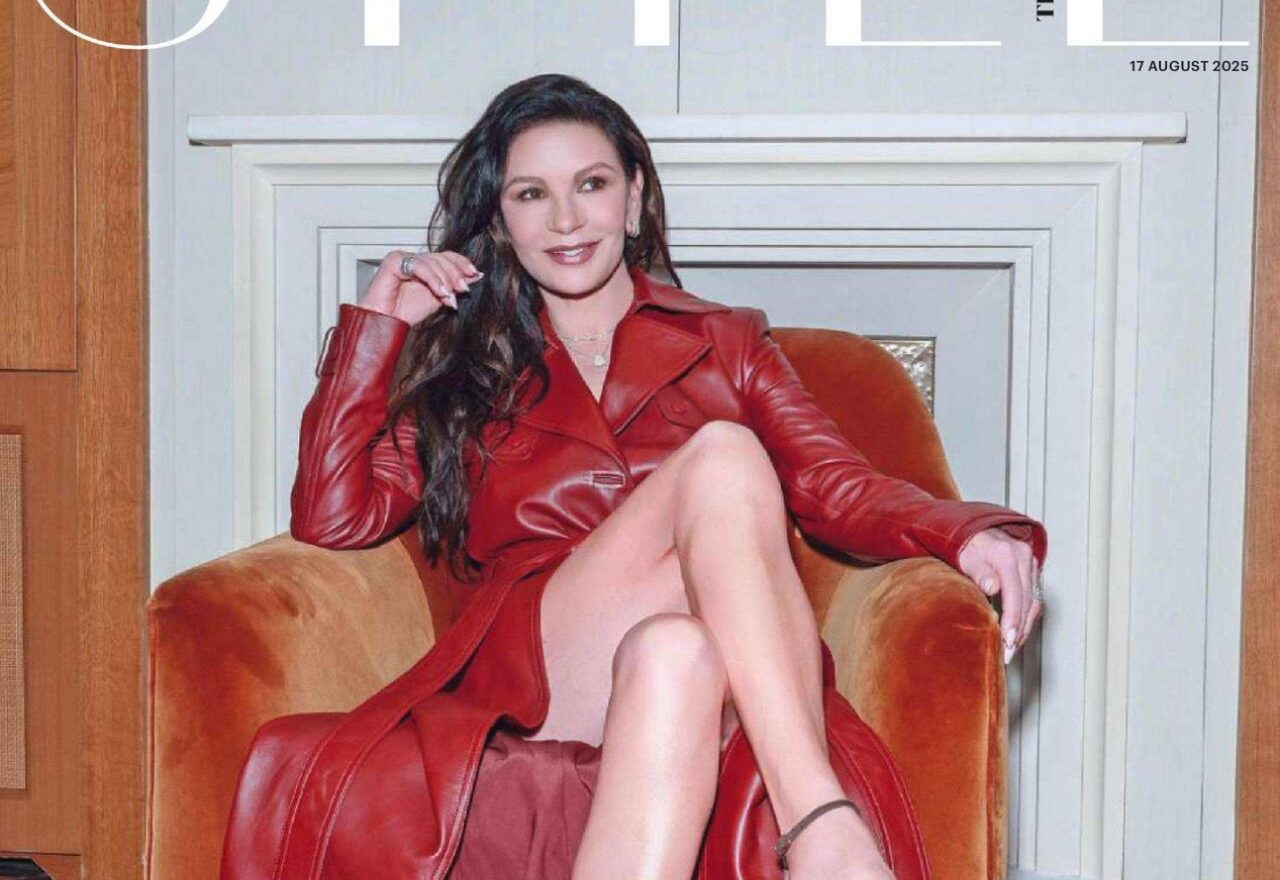
Catherine Zeta-Jones, an icon of effortless glamour, unveils her latest reinvention on the cover of The Sunday Times Style, trading fairytale gowns for a stunning, crimson-hued leather trench—a bold, visceral statement of sartorial power.
There’s a reason certain faces become synonymous with an era. For Catherine Zeta-Jones, it was the late ’90s, a period of cinematic opulence and sleek sophistication that she defined with a whisper-light touch of Old Hollywood magic. But the latest issue of The Sunday Times Style proves that nostalgia is not on her agenda. The cover is a visual jolt, a statement that says, “This is not your mother’s Catherine.”
The image captures Zeta-Jones seated in an inviting, burnt-orange armchair, her posture a mix of relaxed confidence and undeniable allure. The main event? A jaw-dropping red leather trench coat that drapes over her frame like a second skin. Its color is a rich, almost blood-red—a far cry from the delicate florals or classic black she’s often seen in. This is a look of absolute authority, of a woman fully in command of her narrative. The silhouette is at once structured and flowing, with a sharp, tailored collar and a fluid skirt that pools around her. It’s a powerful, almost primal choice—a Velvet Rebellion indeed.

The full-length image on the cover (page 1) shows her legs crossed, revealing a high slit and a pair of equally striking, sheer brown-and-gold heels. The shoes, with their delicate straps and pointed toes, add a layer of feminine vulnerability to the otherwise formidable look. A quick glance at the article (page 11) confirms the outfit’s high fashion pedigree, with credits for the Chanel jacket, trousers, and accessories. Zeta-Jones, in the accompanying interview, talks about her fashion evolution, a process she describes as “just a feeling.”
Beyond the leather, the editorial’s fashion story extends to a series of archival images that place the star in different contexts—from her early career in “The Darling Buds of May” to her role in “The Mask of Zorro.” The text details her career trajectory and her life with Michael Douglas. The article (page 16) also touches on her family, including her children, Dylan and Carys, and her late father-in-law, Kirk Douglas, highlighting her deep connections to both her personal life and her career.
In the interview, Zeta-Jones references her character Morticia Addams in the Netflix series “Wednesday,” describing her as “very glamorous and very fashionable.” This role, she notes, offered a new kind of “rehabilitation” and a departure from her previous work. She also mentions her ongoing collaboration with director Tim Burton, a partnership that seems to have reignited her creative spark.
Styling credits, including photography by James D Kelly and styling by Marian Nachmia, ensure every detail feels intentional. The editorial is a masterclass in re-branding, using fashion as a tool to signal a new chapter. Zeta-Jones’s choice to embrace a bolder, more assertive aesthetic feels like a natural progression—a star no longer playing a part, but owning her own spotlight. The entire spread is a testament to her enduring appeal and her ability to adapt and reinvent her image without losing her core identity.